Sol-Go Flexible Solar Panels
The Power to Move You Forward
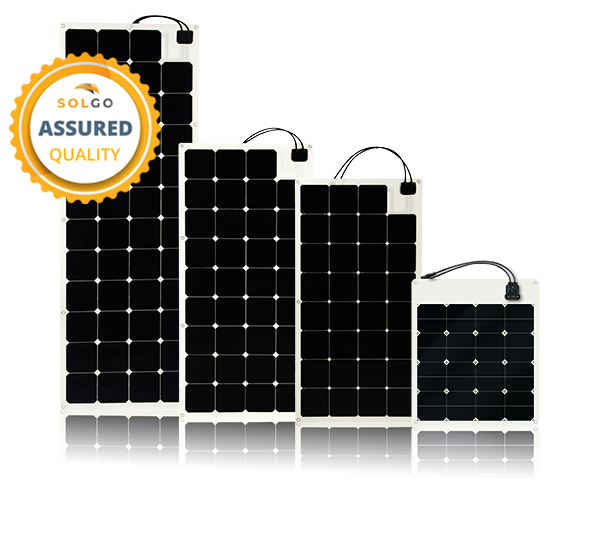
Sol-Go Flexible Solar Panels

F105 Eagle Solar Panel
Originally designed for US Military, our Eagle solar panel is built lightweight and rugged for any adventure

Highest output on the market

Maximum efficiency monocrystalline silicon cells

100% designed and manufactured by Sol-Go

Record level worldwide sales with 25K+ panels delivered since 2019

5-year power output warranty (min 80% with no saltwater exclusion)

Unique design features to increase strength and minimise losses from shading

MC4 (IP68) connectors fitted as standard

Custom OEM sizes available
Fundamentally Different, and Better
SunPower Maxeon Solar cells are designed to be different, and proven to be better across more than five cell generations, 3.5 billion cells even in the harshest of conditions.
Conventional solar cells lose power over time because of corrosion and breakage.
The unique design of SunPower Maxeon solar cells eliminates 86% of the reasons that conventional cells fail.
Why Choose Sol-Go?

- Maxeon are global leaders in solar panel innovation and technology
- Unmatched reliability and efficiency
- Unique patented cell architecture performs better in cloudy weather and partial shade
- Extremely flexible making them well suited for use in flexible panel applications
- Back contact design provides higher strength / increased durability (cell will usually continue working even after localised impact damage)
- Patented cell interconnections used to withstand the expansion and contraction caused by daily temperature changes
- Solid copper base provides high resistance and eliminates corrosion and cracking
- Maxeon cells are typically 3 times the cost of standard monocrystalline cells

- Lower cost, less efficient, conventional monocrystalline cells used, resulting in lower level solar energy conversion
- Much less flexible and so not ideally suited to flexible panel applications
- Front side cell to cell electrical connections are more prone to impact damage, stress fractures, and/or salt water corrosion, resulting in more cell failures and complete loss of cell output
- Thin wire cell interconnections prone to fail with flexing and temperature variations
- Porous metal paste on rear side of cell prone to corrosion
- Textured covering often used which will trap salt/dirt etc and limit light absorption
- Sol-Go panels are manufactured in their own production plant where they are able to maintain high quality standards and level costs
- Waterproof (IP68) fully potted junction boxes
- 5 year warranty on power output (with no salt water exclusion)
- Often private label brands that “out source” production with limited or no influence on quality or costs
- Inferior materials and components used e.g. non-potted junction box
- Warranty often excludes or does not mention salt water applications
- Maxeon are global leaders in solar panel innovation and technology
- Unmatched reliability and efficiency
- Unique patented cell architecture performs better in cloudy weather and partial shade
- Extremely flexible making them well suited for use in flexible panel applications
- Back contact design provides higher strength / increased durability (cell will usually continue working even after localised impact damage)
- Patented cell interconnections used to withstand the expansion and contraction caused by daily temperature changes
- Solid copper base provides high resistance and eliminates corrosion and cracking
- Maxeon cells are typically 3 times the cost of standard monocrystalline cells
- Sol-Go panels are manufactured in their own production plant where they are able to maintain high quality standards and level costs
- Waterproof (IP68) fully potted junction boxes
- 5 year warranty on power output (with no salt water exclusion)
Conventional solar cells used
- Lower cost, less efficient, conventional monocrystalline cells used, resulting in lower level solar energy conversion
- Much less flexible and so not ideally suited to flexible panel applications
- Front side cell to cell electrical connections are more prone to impact damage, stress fractures, and/or salt water corrosion, resulting in more cell failures and complete loss of cell output
- Thin wire cell interconnections prone to fail with flexing and temperature variations
- Porous metal paste on rear side of cell prone to corrosion
- Textured covering often used which will trap salt/dirt etc and limit light absorption
- Often private label brands that “out source” production with limited or no influence on quality or costs
- Inferior materials and components used e.g. non-potted junction box
- Warranty often excludes or does not mention salt water applications